

In the PMP® Examination Content Outline (ECO), under Domain III: Business Environment, Task 8: Evaluate external business environment changes, the primary enabler is “Survey changes to the external business environment (e.g., regulations, technology, geopolitical, market).”
To master this topic for the PMP exam, candidates must understand that projects do not operate in isolation. A contemporary project exists within an organization’s internal environment, which in turn is embedded in a dynamic, shifting external business environment.
1. Context and the VUCA Environment
Historically, project management focused heavily on internal execution within fixed constraints (time, cost, and scope). Modern standards emphasize that project managers must act as strategists and change agents who align deliverables with evolving business objectives and value propositions.
The modern external environment is characterized as a VUCA World:
- Volatility: The rate and severity of unpredictable change.
- Uncertainty: A lack of clarity or awareness regarding future events, options, and outcomes.
- Complexity: Systems with multiple interconnected variables, making cause-and-effect relationships difficult to isolate.
- Ambiguity: Unclear or misleading situations that create multiple possible interpretations.
Because external conditions change rapidly, a project manager must continuously scan the macro-environment to anticipate threats, capture market opportunities, and ensure the project remains viable and value-driven.
2. External Enterprise Environmental Factors (External EEFs)
In PMI methodology, influences on a project are divided into Enterprise Environmental Factors (EEFs) and Organizational Process Assets (OPAs). While OPAs are internal assets (such as templates, procedures, and historical repositories), EEFs originate outside the immediate control of the project team.
EEFs are classified into Internal (e.g., company culture, infrastructure, software) and External. As defined in the PMBOK® Guide (8th Edition), External EEFs form the primary categories that a project manager must survey:
| Marketplace Conditions & Competitors | Legal Restrictions & Compliance | Government/Industry Standards |
| Financial Considerations | Physical & Geopolitical Elements | Emerging Technologies & Innovations |
| Social & Cultural Influences | Academic Research & Industry Trends | Public Health & Safety Mandates |
Detailed Breakdown of External EEF Categories:
- Marketplace Conditions: Market share, competitor actions, brand recognition, buyer/supplier power, and customer behavior shifts.
- Legal Restrictions: Federal, state, or international laws concerning data privacy, security, employment, and trade constraints.
- Government or Industry Standards: Mandatory regulations regarding product quality, environmental impact, workmanship, and safety standards.
- Financial Considerations: Macroeconomic indicators such as currency exchange rates, inflation rates, interest rates, tariffs, and tax policies.
- Physical Environmental & Geopolitical Elements: Climate conditions, weather disruptions, natural resource limits, political stability, and international conflicts.
- Emerging Technologies and Innovations: Advancements in Artificial Intelligence (AI), Generative AI (GenAI), automation, blockchain, and cloud ecosystems.
- Social and Cultural Influences: Demographic shifts, ethical considerations, public perceptions, and changing consumer lifestyles.
- Public Health and Safety Regulations: Emergency protocols, travel restrictions, quarantine measures, and safety guidelines.
- Academic Research & Commercial Databases: Industry studies, benchmarking data, and standardized cost/risk databases.
3. Analytical Frameworks for Surveying the External Environment
To systematically survey the external environment rather than relying on unstructured observations, project leaders utilize formal analytical tools and risk prompt lists.
A. The PESTLE / PESTEL Framework
The PESTEL model is a strategic scanning tool that categorizes macro-environmental forces into six core dimensions:
| Factor | Description | Example Impact on Projects |
|---|---|---|
| P – Political | Government stability, trade policies, tax tariffs, and political climate. | Changes in government leadership shifting project funding priorities. |
| E – Economic | Inflation rates, interest rates, exchange rates, and market boom/bust cycles. | Rising material costs requiring cost-baseline revisions or budget adjustments. |
| S – Sociocultural | Population demographics, dietary trends, education levels, and social values. | Shift toward health-conscious lifestyles altering product requirements. |
| T – Technological | Rapid technical innovation, rate of obsolescence, and AI adoption. | A new software platform rendering current project technology obsolete. |
| E – Ecological | Environmental sustainability, natural resource consumption, and climate impacts. | Mandatory carbon footprint reporting (e.g., CSRD, IFRS S2) imposing new scope. |
| L – Legal | National or local regulatory frameworks, employment laws, and data protection. | New privacy laws requiring additional data encryption user stories. |
The PESTEL Framework diagram illustrates the firm at the center, surrounded by Political, Economic, Social, Technological, Environmental, and Legal forces. The model visually reinforces that external forces generate both opportunities (to be captured) and threats (to be mitigated) through strategic projects.
B. Porter’s Five Forces Model
To survey industry-specific competitive pressures, project managers evaluate Porter’s Five Forces:
- Threat of New Entrants: Ease with which new global competitors can enter the market (e.g., internet-based startups operating internationally).
- Bargaining Power of Suppliers: Concentration of key suppliers controlling raw materials or technical expertise.
- Bargaining Power of Buyers: Customer sensitivity to price, alternative choices, and demand options.
- Threat of Substitute Products: Alternative products or services that perform the same business function.
- Rivalry Among Existing Competitors: Intensity of competition among established market players.
It displays the central competitive space flanked by suppliers, buyers, potential entrants, and substitute products`. The strategic goal is to maximize the gap between Value delivered (V) and Cost incurred (C) $(V – C)$, establishing competitive barriers to entry.
C. Risk Prompt Lists (PESTLE, TECOP, VUCA)
During risk identification, project teams use prompt lists—predetermined lists of risk categories—as brainstorming frameworks for identifying macro-level sources of overall project risk:
- PESTLE / PESTEL: Political, Economic, Sociocultural, Technological, Legal, Environmental.
- TECOP: Technical, Environmental, Commercial, Operational, Political.
- VUCA: Volatility, Uncertainty, Complexity, Ambiguity.
D. SWOT Analysis Integration
Environmental scanning feeds directly into a SWOT Analysis (Strengths, Weaknesses, Opportunities, Threats):
- Internal Factors (Strengths & Weaknesses): Enterprise capacity, staff competencies, and infrastructure that the organization can adjust.
- External Factors (Opportunities & Threats): Market trends, technological shifts, and competitor actions to which the organization must react.
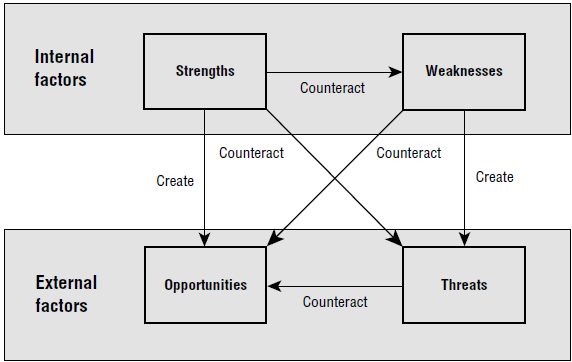
The SWOT maps how internal strengths counteract external threats and create new opportunities, while highlighting internal weaknesses that must be mitigated to prevent external threats from materializing.
4. Strategic Drivers of Change in Agile and Adaptive Approaches
In adaptive, agile, and hybrid environments, surveying the external environment is not a one-time initiation exercise; it is a continuous sensing loop. The Agile Practice Guide (2nd Edition) highlights four primary external strategic change drivers:
- Market and Competitive Pressure: Competitor pricing shifts, new feature launches, or changing customer expectations.
- Compliance and Policy Mandates: Legal deadlines, security standards, and regulatory audits.
- Technology and Operating Model Shifts: Platform updates, cloud automation, or AI integration.
- Closing Value Gaps: Unmet business strategy targets that require updating product capabilities.
| Market & Competitive Pressure: – New competitor offerings – Price shifts & disruption | Compliance & Policy Mandates: – Statutory deadlines – Mandatory audit standards |
| Technology & Operating Shifts: – Platform automation & GenAI – Disruptive industry tech | Closing Strategic Value Gaps: – Shifting business models – Evolving customer demand |
This aligns with Enterprise Agility—the enterprise-wide capability to dynamically reprioritize, pivot, or terminate initiatives based on changing market realities4144—and the M.O.R.E. principles (Relentlessly reassess and Expand perspective).
5. Translating Environmental Survey Results into Project Action
When a survey identifies a change in the external environment (e.g., a new competitor product, a regulatory mandate, or a major price jump in materials), the project manager must evaluate the impact and take appropriate action based on the delivery approach used.
                     EXTERNAL ENVIRONMENT CHANGE DETECTED
                                      │
                                      ▼
                      Impact & Risk Analysis Conducted
                                      │
         ┌────────────────────────────┴────────────────────────────┐
         ▼                                                         ▼
 PREDICTIVE / TRADITIONAL                               ADAPTIVE / AGILE
 (Plan-Driven Approach)                              (Value-Driven Approach)
         │                                                         │
         ├─ Formulate Change Request                               ├─ Record Item in Product Backlog / Scope Bank
         ├─ Assess Triple Constraint Impact                        ├─ Evaluate Business Value, Risk,
         │  (Cost, Schedule, Scope, Quality)                       │  & Dependencies
         ├─ Submit to Change Control Board (CCB)                   ├─ Product Owner Reprioritizes Backlog
         └─ Update Baselines upon Approval                         └─ Incorporate into Upcoming Iteration/Sprint
A. Action in Predictive / Traditional Projects
- Formal Change Control: Proposed scope modifications pass through the formal Integrated Change Control process.
- Impact Analysis: The project manager generates a Project Impact Statement (PIS) detailing how the external change affects the performance measurement baseline (scope, schedule, cost, and quality).
- CCB Evaluation: The Change Control Board (CCB) reviews, accepts, rejects, or defers the change. Approved changes result in formal updates to baseline documentation.
B. Action in Adaptive / Agile Projects
- Backlog Management & Refinement: Rather than treating scope changes as disruptions, agile teams embrace change as discovery.
- Scope Bank / Backlog: External changes are logged as new user stories, features, or non-functional requirements in the Product Backlog (or Scope Bank).
- Product Owner Reprioritization: The Product Owner (or Product Manager) evaluates the business value and risk of the new item relative to existing items, ranking it higher or lower for upcoming iterations.
C. Life Cycle Adaptation and Tailoring
If external volatility becomes extreme, the project manager may need to tailor the overall delivery approach:
- Shortening Timeboxes: Reducing iteration lengths (e.g., from 4 weeks to 2 weeks) to increase feedback frequency.
- Shifting Approaches: Transitioning from a purely predictive model to a Hybrid or Adaptive framework if requirements become volatile due to market disruption.
6. PMP Exam Synthesis & Decision-Making Guidelines
For PMP candidates, scenario questions regarding the external business environment test your ability to follow proper PMI governance procedures. Apply these core principles when answering exam questions:
| Scenario / Situation | Correct PMBOK Action | Incorrect / Trap Action |
|---|---|---|
| A new regulation or legal requirement is passed during project execution. | Analyze the impact on project scope, compliance requirements, and deliverables, then follow change control/backlog refinement procedures. | Panic, stop the project immediately, or implement changes without analyzing impact. |
| A competitor releases a disruptive feature that threatens project market value. | Collaborate with the Product Owner/Sponsor to evaluate business value, conduct impact analysis, and reprioritize the backlog or submit a change request. | Ignore the competitor because “the scope baseline is locked,” or unilaterally alter scope without stakeholder alignment. |
| External supply chain disruptions increase resource costs or lead times. | Perform risk and variance analysis, review risk response strategies, evaluate reserve availability, and communicate impacts to key stakeholders. | Silently absorb costs, cut quality testing, or pad estimates without documenting assumptions. |
| The enterprise strategy shifts due to global market conditions. | Evaluate project strategic alignment, verify the business case, and consult leadership to confirm if the project should continue, be rescoped, or be closed. | Continue executing work that no longer delivers business value just because it was approved. |
💡 Key Takeaway for the Exam: Always assess, evaluate, and analyze before taking action. Surveying the external environment is a continuous process that ensures the project delivers realized business value that remains aligned with organizational strategy.